Executive search
Beyond the CV: the documents executive search firms bill for, in your own template
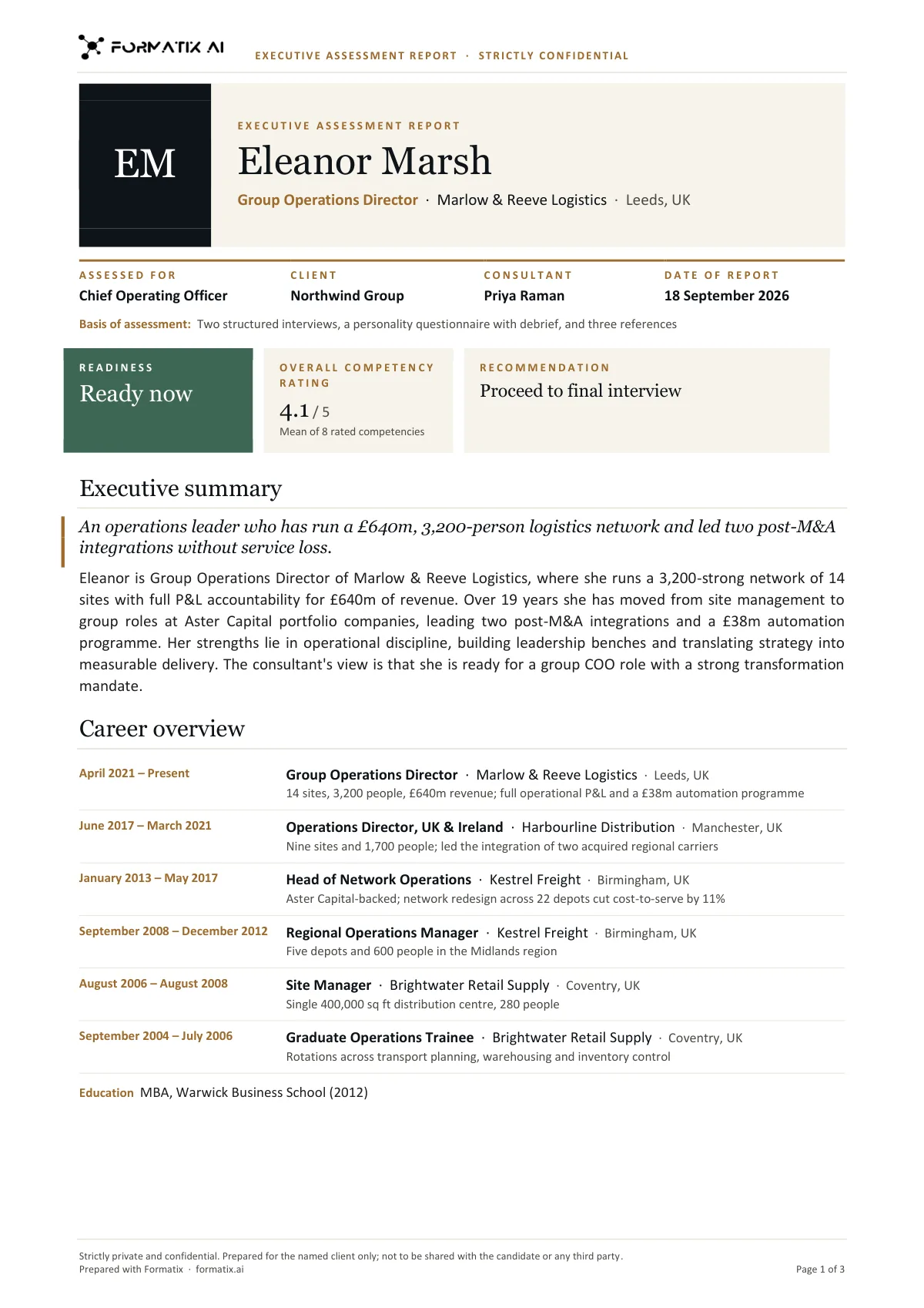
A retained search is judged on its documents: the assessment report on each finalist, the one-page profiles the board reads, the shortlist deck presented at the progress meeting and, for in-house teams, the succession pack that goes to the nominations committee. Formatix takes the material you already hold, the candidate's CV, your interview notes, the ratings you gave and the psychometric results you are licensed to use, and lays it into your firm's own Word, PowerPoint, Excel or PDF template. The judgement is yours. The assembly is ours.
No credit card. Your 10 free credits never expire.
Five documents, one set of inputs
Each page explains the document, what goes in, what comes out and how your brand is kept, with a sample built for a fictional candidate on a Formatix-owned demo template.
Executive assessment reports
Interview notes, the CV, your competency ratings and psychometric results laid into your firm's assessment report, with rating bars drawn from your scores.
Read moreBoard and CEO candidate reports
One-page executive profiles, full candidate reports for the nominations committee and blind profiles for confidential longlists.
Read moreShortlist and longlist decks
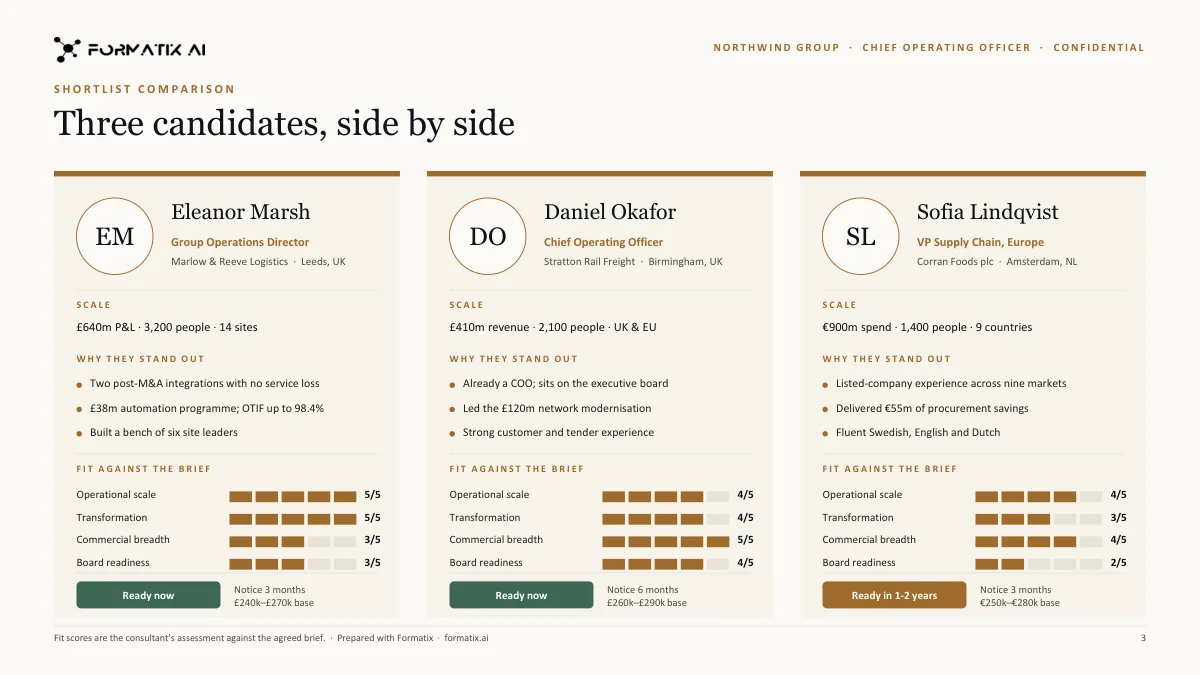
One slide per candidate in your PowerPoint design, comparison slides and a matching Excel tracker, from the same batch of CVs.
Read moreSuccession planning and talent-review packs
For CHROs and talent teams: 9-box grids, succession slates with readiness ratings, successor profiles and promotion cases in your template.
Read morePsychometric results in your report
Results you hold from Hogan, SHL, Saville Wave, DISC and similar instruments, charted in your house style inside your own report.
Read more
The documents a retained search is judged on
Most CV formatting software was built for agency recruitment, where the deliverable is a reformatted CV. Executive search is different. By the time a candidate reaches a client in a retained search, they have been interviewed, assessed against a competency framework, often profiled with a psychometric instrument, and referenced. The client does not pay for a tidier CV. It pays for the consultant's view of the candidate, and that view reaches the client as a document.
Those documents take a long time to build. Each one pulls from several sources, the CV, the consultant's notes, rating sheets, a provider's results PDF, and each has a precise house layout the firm has refined over years: the cover page, the order of sections, the way ratings are drawn, the typeface of the headings. Associates and consultants spend evenings copying dates into career tables, redrawing rating bars and fixing page breaks. That is the work Formatix takes on.
What the five document types have in common
The inputs are the same: a CV in any layout and any of 40+ languages, the consultant's notes, the ratings or placements your process produced and, in some cases, the results of a psychometric instrument. The output is always your template, not ours. Formatix builds the template from a document your firm already sends, or from your website branding if you do not have one yet, and keeps its fonts, colours, spacing and layout. Each document can be produced as an editable Word (DOCX) or PowerPoint (PPTX) file so the consultant can make final edits, as an Excel (XLSX) tracker where a table makes more sense, or as a PDF for sending on.
Because every report starts from the same template, a mandate's five finalist reports look as if one hand wrote them, even when three consultants and two associates worked on them.
The consultant owns the assessment
Formatix does not assess candidates, rate competencies, place people on a 9-box grid or interpret psychometric results. It never administers, scores or interprets a psychometric instrument and never produces a Hogan, SHL or Saville report. You upload your notes and the results you hold; Formatix lays them into your report and draws the scores you supply as charts in your house style. Every document can be reviewed and edited before it leaves the firm, and nothing you upload is used to train AI models.
That division of labour matters in executive search, where the firm's reputation rests on the quality of its judgement. A tool that invented an opinion about a CEO candidate would be a liability. A tool that puts your opinion on the page, in your layout, gives you back the evening.
For search firms and for in-house talent teams
Formatix is used by retained executive search firms, and the same approach works for leadership advisory practices, interim management providers and in-house executive talent teams. The succession planning page is written for the CHRO and the head of talent rather than the search consultant, because they are the ones who build those packs. Whichever side of the table you sit on, the documents stay confidential: data is processed in the UK and EU under GDPR, and you can work in the platform, through the API, through the JobAdder integration, or from ChatGPT, Claude and Perplexity through the Formatix MCP server.
Samples from a fictional candidate
These pages were produced by Formatix on Formatix-owned demo templates for an invented candidate. Your documents would use your own templates.
Pricing in one line
Plans start at £20 a month for 20 credits, and every new account gets 10 free credits with no card and no expiry. Full details are on the pricing page.
Questions from search firms and talent teams
- Is Formatix an executive search CRM or ATS?
- No. Formatix produces the documents: assessment reports, candidate profiles, shortlist decks, trackers and talent-review packs, in your own template. It connects to JobAdder and has an API, and you can also simply upload files or use it from ChatGPT, Claude or Perplexity through the Formatix MCP server.
- Does Formatix assess candidates or interpret psychometric results?
- No. The consultant owns the assessment. Formatix never administers, scores, interprets or generates psychometric assessments. You upload your notes, ratings and the results you hold, and Formatix lays them into your branded report, drawing the scores you supply as charts.
- Can we use the report templates we already have?
- Yes, that is the usual starting point. Upload a document your firm already sends and Formatix turns it into a template, preserving fonts, colours, spacing and layout. If you have no house template, it can build one from your website branding.
- Which formats can we produce?
- Word (DOCX), PowerPoint (PPTX), Excel (XLSX) and PDF. Word and PowerPoint outputs stay fully editable so the consultant can make final changes.
- How much does it cost?
- Plans start at £20 a month for 20 credits. Every new account gets 10 free credits, with no card and no expiry.
- Where is candidate and employee data processed?
- In the UK and EU, under GDPR. Nothing you upload is used to train AI models.
Bring one document you already send
Start with the report or deck your firm sends clients today. Formatix turns it into a template, and your next finalist report comes out in exactly that layout.
Hogan, SHL, Saville Wave and DISC are trademarks of their respective owners. Formatix is not affiliated with or endorsed by them.